Product Overview
The Impressed Current Cathodic Protection (ICCP) system is an advanced active electrochemical anti-corrosion technology designed for metal structures such as ships, offshore platforms, and subsea pipelines. By supplying direct current from an external power source to auxiliary anodes embedded in the environment, the system drives current through the electrolyte (e.g., seawater) to the protected steel structure. This forces the structure to polarize to a stable negative potential, effectively suppressing electrochemical corrosion reactions.
Distinguished by its long service life, adjustable output, extensive protection range, and the elimination of frequent anode replacement, the ICCP system offers a comprehensive, cost-effective, and long-term corrosion solution for large-scale marine engineering facilities.
1. Key Application Areas
-
Port and Dock Machinery
-
Coastal Power Plant Facilities
-
Offshore Vessels and Marine Platforms
-
Oil & Gas Transmission Pipelines
-
Wastewater Treatment Plant Equipment
-
Offshore Wind Turbine Foundations
2. System Components
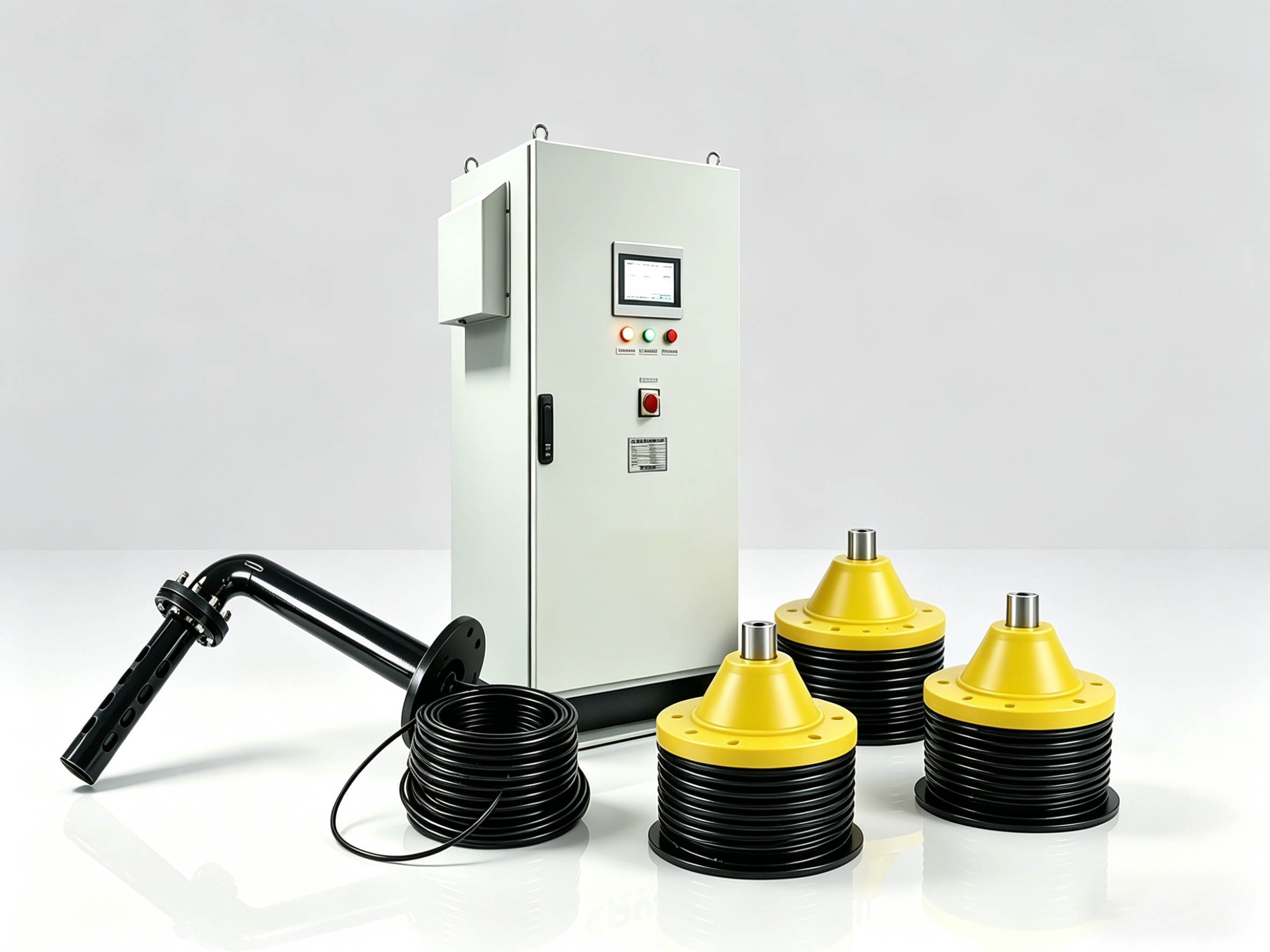
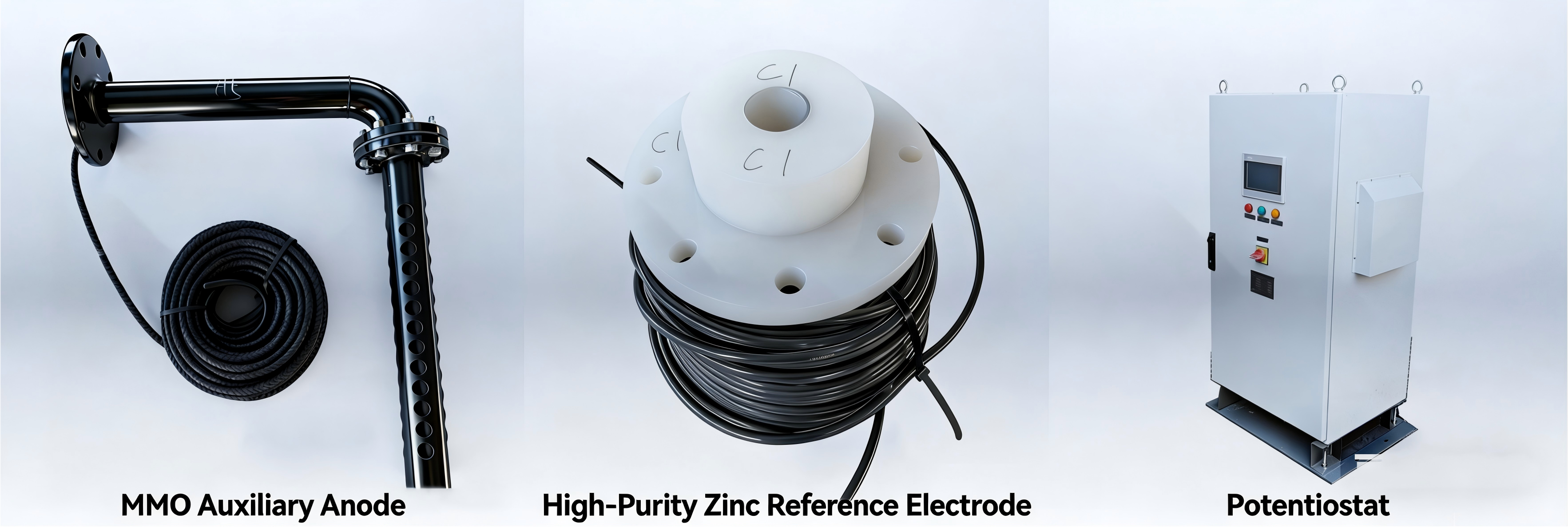
The system comprises three core components: MMO Auxiliary Anodes, High-Purity Zinc Reference Electrodes, and Potentiostats.
A. MMO Auxiliary Anodes
Mixed Metal Oxide (MMO) anodes are critical components in electrochemical applications, particularly in cathodic protection and electrolysis. Constructed with a valve metal substrate (typically titanium) coated with an active layer of mixed metal oxides (such as Ruthenium, Iridium, and Titanium oxides), these anodes facilitate efficient electron transfer during operation. The substrate provides structural integrity, while the coating serves as the active zone for electrochemical reactions.
Key Functions:
-
Current Supply: Continuously releases protective current to drive cathodic polarization on the structure, keeping corrosion rates within safe thresholds.
-
Uniform Distribution: Engineered layouts ensure even current distribution across the entire structure, eliminating risks of local corrosion due to shielding or uneven flow.
-
Environmental Adaptability: Material selection is optimized for specific environments (seawater, soil, etc.) to ensure sustained and stable performance.
Product Highlights:
-
High Catalytic Activity: Significantly reduces overpotential for electrode reactions.
-
Chemical Stability: Maintains stability in corrosive media including acids, alkalis, and salt solutions.
-
Extended Lifespan: Service life exceeds 20 years under normal operating conditions.
-
Low Consumption Rate: Extremely slow self-consumption ensures long-term efficiency.
-
Uniform Current Distribution: Guarantees consistent protection across the metal structure.
B. High-Purity Zinc Reference Electrodes
Constructed with high-purity zinc (≥99.999%) as the active material immersed in a specific electrolyte, these electrodes operate based on the redox equilibrium of zinc. They provide a stable reference potential in various solutions, allowing for precise measurement of the potential difference between the electrode and the protected structure.
Key Functions:
-
Monitoring: Accurately monitors cathodic protection potentials at critical structural points, providing real-time insights into system status.
-
Performance Evaluation: Enables operators to assess protection effectiveness and optimize system parameters as needed.
-
Reference Signal: Provides a stable potential output as a feedback signal for the automatic control system.
-
Current Regulation: Facilitates automatic adjustment of the system's output current to maintain the structure's potential within the designated protection range.
Product Highlights:
-
Stable Potential: Delivers consistent and predictable potential values.
-
Corrosion Resistance: Zinc inherently offers strong resistance to corrosion.
-
Wide Applicability: Suitable for diverse environments, including soil and freshwater.
C. Potentiostats
The Potentiostat is an automatic control device central to electrochemical protection. Utilizing a negative feedback control loop, it continuously monitors the potential of the protected metal structure and compares it with a preset target value. If a deviation is detected, the device automatically adjusts the magnitude and direction of the output current to align the structure's potential with the setpoint, ensuring optimal protection conditions.
Key Functions:
-
Overcurrent Protection: Automatically limits or cuts off output if current exceeds rated values, preventing anode overheating or over-protection of the metal.
-
Overvoltage Protection: Restricts output voltage to safe levels to protect personnel and equipment.
-
Lightning Protection: Built-in surge protectors dissipate lightning-induced currents, safeguarding internal circuits.
-
Data Logging & Remote Transmission: Records key parameters (potential, current, voltage) and supports communication via RS485, 4G, or NB-IoT for remote monitoring and early warning, significantly reducing manual inspection needs.
-
Temperature Compensation: Automatically corrects for potential shifts in the reference electrode caused by temperature fluctuations, ensuring control precision.
-
Humidity Control: Features sealed designs or heating elements to prevent internal condensation and circuit failures.
-
Load Matching: Supports various anode materials and adjusts output characteristics based on environmental resistivity.
Product Highlights:
-
Automatic Control: Precisely regulates output current to maintain stable potential.
-
Superior Output Performance: Wide voltage/current ranges with high output precision.
-
High Reliability: Equipped with comprehensive protection mechanisms (overcurrent, overvoltage, short-circuit).
-
User-Friendly Operation: Intuitive interface and clear display for easy parameter setting and status monitoring.